Views: 0 Author: Site Editor Publish Time: 2026-09-22 Origin: Site


Furniture retailers, developers, and hospitality brands face a constant procurement challenge. You must balance the rapid speed of off-the-shelf procurement against the distinct market differentiation of custom manufacturing. Standard furniture solves immediate inventory needs but often sacrifices long-term brand identity. This decision ultimately relies on a strict strategic calculation. You need to carefully weigh target market spatial constraints, brand aesthetic consistency, and desired profit margins. Relying solely on generic imports leaves your business vulnerable to aggressive price wars and shifting consumer loyalties.
Our primary objective is to provide a rigid, evidence-based framework for your business. Procurement and product teams will learn exactly how to evaluate specific market signals. We will help you determine if investing in custom tooling and proprietary design is financially and operationally justified. By analyzing spatial demands and structural requirements, you can strategically elevate your product lineup.
Customization is viable when standard market dimensions fail your target demographic (e.g., extreme space-saving needs or luxury built-in integrations).
Standardizing your own proprietary shoe cabinet specifications reduces long-term manufacturing variables and improves quality control.
Transitioning to custom production requires a supplier capable of rapid prototyping and transparent MOQ (Minimum Order Quantity) structuring.
The most profitable custom designs focus on modularity and internal functional geometry rather than purely external aesthetics.
Many retailers start by purchasing generic catalog items because they seem easier to source initially. However, standard sourcing creates hidden business risks over time. Generic items carry a very low barrier to entry in the market. Your competitors can buy the exact same units from the same factories. This dynamic inevitably sparks aggressive price wars. Product quality also fluctuates widely between batches when you lack control over the core engineering.
Customizing your proprietary designs fixes these foundational pricing issues. You dictate the pricing architecture entirely when you own the design. No competitor can undercut an item they simply cannot source. Unique functional features justify premium retail price points. This direct control allows brands to substantially expand their overall profit margins.
Chart Title: Generic vs. Custom Procurement Comparison
Procurement Strategy | Barrier to Entry | Pricing Power | Quality Control |
|---|---|---|---|
Standard Off-the-Shelf | Very Low | Weak (Market Driven) | Inconsistent |
Proprietary Custom | High (IP Protected) | Strong (Brand Driven) | Strictly Regulated |
You must define success metrics early in the development phase. Reduced return rates indicate better structural integrity and improved customer satisfaction. A higher customer lifetime value proves your design solves real household problems. Certain commercial contract-fulfillment requirements might also demand exact product dimensions to meet architectural blueprints.
Your customer base often requires hyper-specific solutions based on their geographic location. Urban micro-apartments demand ultra-slim drop-front mechanisms to save hallway space. Standard bulky units simply fail in these environments. If your audience lives in dense cities, customizing a narrow profile becomes a lucrative necessity.
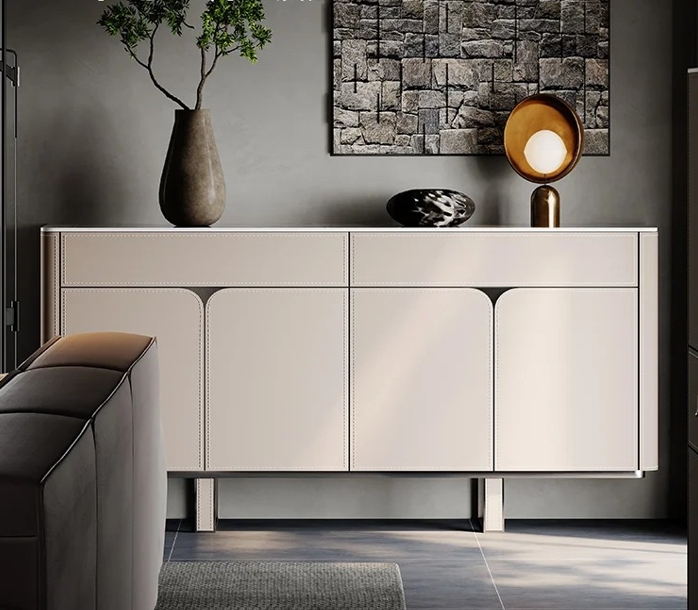
Retailers want their entire furniture collections to match perfectly. You might need to integrate specific material finishes across a whole-house collection seamlessly. For example, harmonizing a white short shoe cabinet with existing minimalist living room collections builds strong aesthetic continuity. Customers prefer buying matching sets, boosting your average order value.
Pay close attention to persistent customer complaints regarding standard market offerings. Poor ventilation routinely ruins expensive leather footwear. Inadequate shelf depth crushes larger men's shoes or winter boots. Failing hinges cause daily frustration. Customization allows you to engineer permanent solutions to these exact consumer grievances.
Real estate developers and hospitality brands operate differently than retail stores. They need recessed, built-in cabinetry as a standard architectural feature. These commercial projects require uniform scaling across hundreds of rooms. Standard units leave unsightly gaps in alcoves, forcing developers to seek custom dimensional manufacturing.
True value lies primarily in the engineering of storage capacity. Internal geometry matters significantly more than purely external styling. Establishing rigid shoe cabinet specifications guarantees structural consistency across massive production runs. A beautiful exterior fails if the interior layout wastes valuable usable space.
You need a standard baseline to evaluate proper storage mechanics. Standard depth typically requires 33 to 35 centimeters for flat storage of adult shoes. Slim profile cabinets need carefully adjusted angles for the drop-down drawers. If shelves angle too steeply, footwear slides and jams the closing mechanism.
Table Title: Baseline Dimensional Guidelines for Development
Cabinet Type | Recommended Depth | Internal Configuration |
|---|---|---|
Standard Flat Storage | 33cm - 35cm | Adjustable horizontal shelves |
Ultra-Slim Profile | 17cm - 24cm | Tilted drop-front drawers |
Boot Storage Hybrid | 40cm minimum | Removable vertical dividers |
Discuss weight distribution requirements extensively during the design phase. Heavy footwear like winter boots demands thicker substrate boards. Bracket selection directly determines shelf lifespan under daily stress. Evaluating standard shoe cabinet models on the open market often reveals structural weaknesses under heavy loads. Upgrading to heavy-duty concealed hinges prevents door sagging over time.
Proper airflow design acts as a non-negotiable structural requirement. Enclosed spaces trap moisture and odors rapidly. You must incorporate louvered doors or back-panel venting into your technical drawings. This critical step prevents product degradation and eliminates downstream customer dissatisfaction.
Securing a technologically advanced shoe cabinet supplier dictates the success of your custom rollout. A reliable factory must offer rapid 3D CAD modeling before any physical cutting begins. Physical sampling allows your product team to run crucial iteration cycles. You must test the ergonomics before committing to mass production.
Evaluate your manufacturing partner's adherence to global environmental emission standards. Ask for verified CARB Phase 2 compliance certificates for all engineered woods. Request FSC certification documentation if your brand highlights sustainability. Transparent material traceability protects your brand reputation from regulatory fines and consumer backlash.
Establish clear legal frameworks for mold ownership early in the negotiation. You must sign robust non-disclosure agreements (NDAs) before handing over any proprietary technical drawings. Protect your unique design investments. Clarify whether you or the factory owns the specific extrusion molds created for your hardware.
Assess their inline inspection processes meticulously. Review their specific packaging drop-test standards to ensure safe international transit. They must scale operations smoothly from initial small batches to high-volume container shipments.
Verify moisture content checks on raw materials before assembly.
Audit their hinge-cycle testing machines on the factory floor.
Confirm they use minimum 5-ply corrugated cartons for final packaging.
Review their protocol for handling defective units discovered during QA.
Analyze the reality of initial tooling and research investments. Custom molds and specialized jigs require upfront capital. However, this initial outlay balances against a stabilized, lower unit cost at scale. By cutting out trading company markups, direct factory customization often becomes highly profitable over a two-year product lifecycle.
Map out a realistic timeline to manage inventory expectations. The journey from initial concept to a stocked warehouse spans multiple distinct phases.
Initial CAD approval and engineering reviews (10-15 days).
First-round physical sampling and physical adjustments (20-30 days).
Mass production and packaging completion (30-45 days).
Ocean freight and final port customs clearance (30-40 days).
This entire process typically takes 90 to 120 days depending on hardware availability.
We recommend starting your transition using a hybrid custom approach. Keep a standard internal carcass dimension to save on structural tooling costs. Simply add custom door panels, unique hardware, and proprietary finishes. This smart strategy tests market appetite safely before committing to a ground-up structural redesign.
The decision to customize should rely strictly on measurable gaps in your current product catalog. You must prioritize specific audience needs over pure vanity metrics. Success hinges equally on rigorous engineering specifications and the operational maturity of your chosen manufacturing partner. Standardizing your approach protects your profit margins and brand integrity simultaneously. We advise you to audit your current top-selling generic models today. Identify their consistent pain points to draft your very first custom technical brief.
A: MOQs vary significantly by the chosen material. Standard melamine finishes typically require 50 to 100 units per SKU. Custom wood veneers or highly specific hardware molds generally push MOQs to 200 units to ensure cost-effective production runs.
A: Initial physical samples typically require 15 to 30 days after you approve the final CAD drawings. This timeline depends heavily on specialized hardware availability and the complexity of the internal geometry.
A: Yes. Modular interior customization is the most cost-effective way to differentiate your product. Implementing adjustable slanted shelves or variable peg holes allows immense flexibility without incurring high structural tooling costs for new exterior dimensions.


