Views: 0 Author: Site Editor Publish Time: 2026-09-23 Origin: Site


Integrating a wine cabinet into a custom interior demands careful planning. You must balance elegant aesthetic integration with rigorous environmental and structural requirements. Generic cabinetry often fails under the immense weight of growing wine collections. Standard units also struggle to handle the intense moisture demands of climate-control systems. This article provides a comprehensive structural and functional framework for your next project. You will learn how to evaluate various materials, calculate cooling requirements, and map out design layouts. We aim to help you solidify these details before you finalize project blueprints or commit to a specialized vendor.
Every successful storage installation starts with accurate mathematics. You cannot design a durable frame without knowing the exact dimensions and weight it will carry. Designers must establish a firm scope before considering wood stains or glass finishes.
You must calculate exact bottle counts early in the process. Ask yourself if the collection requires display-oriented storage or high-density bulk storage. Display-oriented designs place bottles label-forward. This layout highlights specific vintages but dramatically reduces total capacity. High-density storage uses a cork-forward orientation. It maximizes the number of bottles per square foot.
A hybrid approach often works best. You can allocate the top half of the unit for label-forward display. The bottom half can house bulk racking for everyday consumption.
Standardized grids rarely fit modern wine collections. You need to plan internal grid dimensions to accommodate various bottle shapes safely. Standard Bordeaux bottles require a width of 2.75 to 3 inches. Burgundy and Pinot Noir bottles feature wider bases. They need openings between 3.25 and 3.5 inches. Magnums and champagne bottles demand even larger clearances. Failing to diversify the grid means oversized bottles will scrape the racking or simply will not fit.
Location impacts both installation complexity and structural safety. High-value placement zones include dining room transitions, under-stair conversions, and dedicated tasting alcoves. Each location presents unique mechanical challenges. Placing a unit under a staircase requires custom angled framing. Transition zones between a kitchen and dining room often lack the depth needed for proper insulation.
Wine is remarkably heavy. You must factor in dead weight before installing any framework. A standard 750ml bottle weighs approximately three pounds. A 150-bottle cabinet adds more than 450 pounds of concentrated load to a small floor footprint. Add the weight of glass doors, hardwood racking, and a cooling compressor, and the total mass increases quickly. Such heavy installations require reinforced subfloors. You must also anchor the upper sections securely to wall studs to prevent tipping.
Estimated Structural Load Calculation
| Bottle Capacity | Liquid/Glass Weight (lbs) | Cabinet Frame Weight (Est. lbs) | Total Concentrated Load (lbs) |
|---|---|---|---|
| 50 Bottles | 150 | 100 | 250 |
| 150 Bottles | 450 | 250 | 700 |
| 300 Bottles | 900 | 400 | 1,300 |
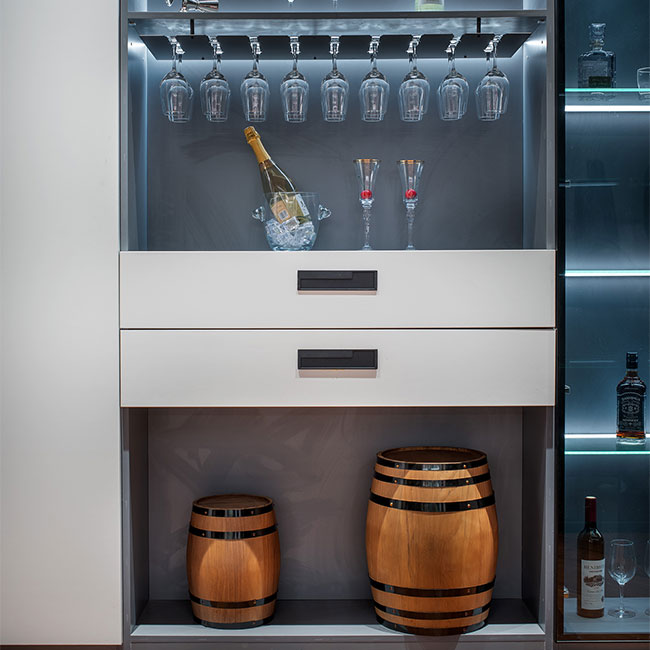
Temperature fluctuations degrade fine wine rapidly. Deciding between passive and active climate control will dictate your entire construction approach.
Passive storage works best for short-term consumption. It also suits homes located in naturally stable environments like subterranean basements. This method requires a lower implementation cost. It carries zero mechanical maintenance. You do not need thick insulation or dedicated power circuits. However, passive storage exposes your collection to seasonal temperature swings. It is never recommended for expensive vintages intended for decades of aging.
Long-term aging requires strict environmental stability. You must maintain temperatures around 55°F and relative humidity between 60% and 70%. Active storage achieves this through specialized mechanical cooling.
If you choose active cooling, you must treat the cabinet as a sealed envelope. Standard cabinetry construction will fail here. Cold air inside the unit will meet warm ambient air outside. This causes severe condensation. To prevent mold and structural rot, you must install closed-cell foam insulation. A dedicated vapor barrier is equally critical. Professionals typically use a 6-mil plastic vapor barrier on the warm side of the framing. This stops moisture migration completely.
You have two primary mechanical paths for active conditioning.
Material choices affect thermal efficiency and visual appeal. High humidity inside an active cabinet tests the limits of raw materials.
Traditional hardwood racking remains a popular luxury choice. Mahogany, redwood, and white oak offer high natural rot resistance. They deliver a classic, timeless aesthetic. Trade-off: They represent the highest price point. Solid wood is also prone to warping if not properly sealed against 70% humidity. You must finish them with specialized, low-VOC clear coats to prevent outgassing from tainting the wine.
Metal pins and acrylic panels create a modern, minimalist aesthetic. They provide high structural integrity and a minimal spatial footprint. Bottles appear to float against the wall. Trade-off: Metal conducts heat rapidly. If your cooling system lacks perfect calibration, metal components can cause localized condensation, leading to dripping water and damaged labels.
Engineered materials offer incredible flexibility. Utilizing a melamine wine storage cabinet presents a highly viable, cost-effective alternative for cabinet carcasses and bulk storage racking.
Material Comparison Summary Chart
| Material Type | Visual Aesthetic | Moisture Resistance | Maintenance Level |
|---|---|---|---|
| Solid Hardwood | Classic / Traditional | High (if sealed correctly) | Moderate |
| Metal & Acrylic | Modern / Minimalist | Very High (beware condensation) | Low |
| Melamine (MR Core) | Versatile / Contemporary | High (requires sealed edges) | Very Low |
Execution details separate a stunning architectural feature from a mechanical disaster. Flawless custom wine cabinet design requires strict attention to lighting, vibration, and airflow.
Lighting serves as both a focal point and a potential hazard. You must avoid halogen or standard incandescent bulbs completely. They emit significant heat. They also produce UV rays. UV radiation alters wine chemistry and degrades flavor profiles rapidly. Solution: Specify recessed, low-voltage LED channel lighting. Use frosted diffusers to soften the glow. Select bulbs with a color temperature around 2700K to 3000K for a warm, inviting ambiance without heat output.
Continuous vibration disturbs the delicate sediment inside aging wine. Over years, this micro-agitation ruins older vintages. Solution: Ensure cooling units and cabinet mounts include heavy-duty rubber dampening pads. If installing a self-contained compressor, isolate its framing from the primary wine racking to prevent mechanical hums from transferring into the bottles.
Mechanical cooling systems need to breathe. Compressors require adequate intake and exhaust airflow to function. Failing to plan these exhaust pathways results in catastrophic system burnout. If a unit vents into tight decorative millwork without a grille, the hot air loops back into the intake. Always verify the manufacturer's required cubic feet per minute (CFM) for airflow. Leave ample clearance behind grilles to allow unimpeded ventilation.
Choosing the right fabricator makes or breaks your timeline. You need partners who understand thermodynamics just as well as joinery.
Show up to your initial vendor meeting prepared. Bring detailed floor plans and exact dimensional limitations. Know your target bottle count. Bring MEP (Mechanical, Electrical, Plumbing) schematics for the surrounding room. Providing these elements upfront allows the vendor to identify immediate spatial conflicts.
Do not hire a standard kitchen cabinet maker for an active wine room. Use this checklist to vet specialists properly:
Before signing a contract, request a physical material sample kit. You need to test finishes against your home's existing lighting. Also, demand a preliminary BTU calculation based on your room's thermal load. A vendor who guesses cooling requirements without doing the math poses a massive risk to your wine collection.
Successful custom wine storage remains an engineering project first and an aesthetic project second. Overlooking weight capacities, thermal insulation, or airflow will turn a beautiful installation into a structural liability. You must choose materials wisely. Options like moisture-resistant melamine provide excellent utility without sacrificing style. Most importantly, align your general contractors, HVAC specialists, and cabinet makers early in the design phase. Open communication across these disciplines will help you avoid costly retrofits and protect your vintage collection for decades.
A: Standard single-deep storage requires a minimum of 13.5 to 14.5 inches of internal depth to fully conceal the bottle neck. If you plan to incorporate display rows angled forward, you may need an internal depth closer to 15 or 16 inches. Double-deep storage typically requires at least 26 inches.
A: Yes, provided the melamine is applied over a moisture-resistant core (like MR-MDF) and the cabinet's edges are properly sealed against the 60-70% humidity required for aging. Standard particleboard cores will absorb ambient moisture, swell, and fail over time. Proper edge-banding is crucial.
A: Yes. If integrating a self-contained or split cooling system, a dedicated 15-amp or 20-amp circuit is standard practice to prevent power fluctuations that can damage the compressor. Sharing a circuit with kitchen appliances can trigger breakers and leave your wine unprotected.
A: Functional custom cabinets can be designed for spaces as narrow as 18-24 inches, utilizing vertical height and single-bottle depth for efficient footprint utilization. Narrow columns work well in transition zones or beside kitchen pantries, provided they have adequate ventilation for cooling units.


