Views: 0 Author: Site Editor Publish Time: 2026-10-01 Origin: Site


Choosing between cabinet materials requires balancing immediate visual impact against long-term maintenance realities. Cabinet finishes dictate 80% of a kitchen's visual appeal. They also bear the brunt of daily physical wear in any busy household. The wrong choice leads to irreparable water damage or constant touch-ups.
We aim to strip away marketing claims and provide a standardized evaluation framework. You will learn how to match the correct finish to your specific household traffic and aesthetic goals. We will explore the physical engineering, durability, and practical design capabilities of these popular finishes. This knowledge ensures you make an informed decision based on facts rather than trends.
You must establish baseline definitions to anchor your comparison on physical properties rather than marketing buzzwords. Each material relies on distinct manufacturing processes. These processes directly dictate how they perform in a home environment.
Melamine, often referred to as Thermal Fused Laminate (TFL), begins as resin-saturated paper. Manufacturers thermally fuse this paper to a particleboard or Medium Density Fiberboard (MDF) core. They apply high heat and pressure to create a hardened surface.
The implementation reality heavily depends on the edge banding. The core board remains vulnerable on its exposed sides. You should look for PUR (Polyurethane) or laser edge banding. PUR adhesives create a chemical bond that resists moisture penetration. Traditional EVA adhesives can fail near heat sources like ovens. If moisture breaches a weak edge, the core will swell irreparably.
Lacquer is a liquid coating sprayed in multiple thin layers. Common formulations include nitrocellulose, acrylic, or catalyzed resins. The solvent evaporates, and the resin cures into a hard, seamless shell over a wood or MDF substrate.
The implementation reality demands extreme precision. Cabinet makers require a dust-free, climate-controlled spray booth to achieve a flawless finish. Post-catalyzed lacquers offer superior chemical resistance. However, they require strict application standards. Poor application leads to microscopic pinholes, cracking, or prolonged off-gassing in your home.
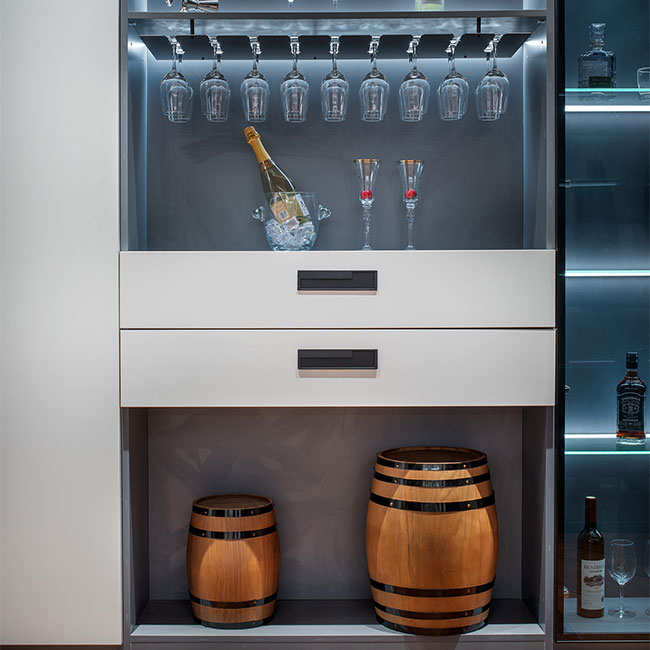
You need to compare how both materials handle the physical realities of a working kitchen. When comparing melamine vs lacquer cabinets, the daily environmental stress reveals their true strengths and weaknesses.
Melamine provides highly durable scratch resistance. It easily withstands sliding heavy pots, pans, and countertop appliances. The thermal fusing creates a tough outer shell. You can brush against it repeatedly without leaving scuff marks.
Lacquer cures hard but remains brittle. It is highly susceptible to impact chipping. Dropped utensils, aggressive door closures, or bumping a chair into a base cabinet can easily crack the finish. Once the seal breaks, the underlying MDF becomes vulnerable.
Melamine boasts excellent surface water resistance. Water beads up on the resin face. However, it remains highly vulnerable at the seams. If water breaches the edge banding through capillary action, the core will permanently expand. You must wipe up spills near sink bases immediately.
Lacquer creates a seamless, waterproof seal. It encapsulates the front and edges of the door. This seamless nature protects the substrate well. However, standing water can chemically break down the lacquer over time. Prolonged moisture exposure leads to bubbling, peeling, or a cloudy appearance.
Melamine features strong UV stability. Woodgrain or solid color prints will not noticeably fade or shift over time. Sunlight streaming through large kitchen windows will not alter the surface hue.
Traditional nitrocellulose lacquers yellow with age. The chemical makeup degrades under UV light. You must specify non-yellowing acrylic or catalyzed lacquers for white or light-colored finishes. If you skip this specification, crisp white cabinets may turn a dingy cream within a few years.
Aesthetics matter just as much as durability. You must evaluate the visual capabilities of each material. Consider how they align with your architectural styles and design goals.
Lacquer is the only choice for routed, raised panel, or Shaker doors. The liquid application coats complex profiles seamlessly. It flows into grooves and corners to create a unified surface. This flexibility makes it a staple in high-end custom cabinetry. You can achieve classic, transitional, or modern aesthetics.
Melamine strictly limits you to flat slab doors. Attempting to route melamine exposes the raw MDF or particleboard core. Manufacturers cannot apply the rigid resin paper into curved grooves. If you want a minimalist, European-style aesthetic, melamine fits perfectly. If you want depth and shadow lines, it will fall short.
Lacquer offers limitless custom color-matching. You can match a specific paint swatch, a piece of artwork, or historical trim. Cabinet makers can also adjust the sheen level precisely. You can select an ultra-matte 5% sheen or a mirror-like 90% high-gloss finish. This allows for total aesthetic control.
Melamine relies on pre-manufactured colors and textures. Custom color creation is impossible for individual buyers. However, the industry has advanced significantly. High-quality textured melamine now offers realistic Thermo Structured Surfaces (TSS). These synchronized woodgrains mimic natural wood beautifully. The physical texture aligns perfectly with the printed grain pattern.
Consider these design limitations when planning your space:
You must analyze the long-term upkeep required for your chosen finish. Maintaining a kitchen involves constant cleaning and inevitable accidents. Each material demands a different approach to ongoing care.
Melamine tolerates standard household degreasers and multi-purpose cleaners. The resin surface resists chemical damage from most mild everyday products. You can wipe away grease spatters easily. A simple damp cloth removes most daily grime.
Lacquer requires delicate handling. You must use pH-neutral cleaners and soft microfiber cloths. Harsh chemicals will strip the protective topcoat. Abrasive sponges will create micro-scratches that dull the sheen. You should never use ammonia-based glass cleaners or abrasive scouring powders on lacquer surfaces.
Melamine damage remains permanent. A chipped edge or deep scratch cannot be sanded or filled. The only solution for severe damage requires replacing the entire door. Finding an exact match years later can prove difficult if the manufacturer discontinues the color.
Lacquer offers high repairability. Professional finishers can fill chips, sand the area smooth, and color-match the spot. Furthermore, you can completely sand and respray lacquer doors decades later. This allows you to update the kitchen's look without replacing the physical cabinet boxes.
Cabinet Maintenance Comparison Summary
| Feature | Melamine (TFL) | Lacquer Finish |
|---|---|---|
| Daily Cleaning | Tolerates standard mild degreasers. | Requires pH-neutral soap and microfiber. |
| Scratch Repair | Impossible; requires door replacement. | Can be sanded, filled, and spot-sprayed. |
| Stain Resistance | High resistance to food stains. | Susceptible to prolonged acidic spills. |
| Long-Term Update | Cannot be painted over easily. | Can be fully stripped and repainted. |
You do not have to choose just one material for an entire house. Actionable recommendations depend on placing materials based on environmental demands. Zoning your home ensures optimal performance.
Melamine excels in high-traffic zones. You should specify it for base cabinets, laundry rooms, and walk-in pantries. These areas experience constant physical contact from shoes, vacuum cleaners, and heavy items.
It also works perfectly for secondary specialty storage. Durability outweighs luxury aesthetics in these spaces. For example, a basement melamine wine cabinet resists humidity well. It easily handles the heavy sliding of glass bottles without scratching. You should also consider melamine for rental properties or multi-family developments. Tenant wear-and-tear remains a primary concern in these environments.
Lacquer shines in primary display kitchens. High-value real estate demands premium finishes. You should specify it when specific historical or architectural color matching is required.
Complex custom builds absolutely require lacquer. If your design features integrated handles, fluted wood panels, or traditional Shaker profiles, liquid finishes provide the only viable solution. Lacquer elevates the visual prestige of any prominent living space.
A hybrid approach often yields the best results. You can use durable woodgrain melamine for lower cabinets. Shoe scuffs and impacts happen most frequently near the floor. You can then use custom-color lacquer for upper cabinets. This draws the eye upward, elevates the design, and keeps the delicate finish away from heavy foot traffic.
There is no universal best finish for cabinetry. There is only the right finish for your specific risk tolerances and lifestyle habits. Melamine provides incredible scratch resistance and easy daily cleaning. Lacquer provides unmatched aesthetic flexibility and seamless profiles.
We recommend you explicitly ask your cabinet maker about their edge-banding techniques if you choose melamine. Specifically request PUR or laser banding. If you choose lacquer, demand top-coat catalysts to prevent yellowing.
Take time to audit your household traffic. Prioritize your need for custom profiles versus flat-slab durability. Finally, request physical samples of both materials. Test them under your home's specific lighting and subject them to your own scratch tests before signing a final contract.
A: Yes, but it requires a specialized bonding primer like shellac or polyurethane-based primers. You must perform thorough scuff-sanding to give the surface tooth. However, a hand-painted melamine surface will never look as seamless or smooth as factory-applied lacquer.
A: High-gloss melamine or acrylic-faced MDF can achieve a similar mirror-like finish on the face. However, lacquer provides a superior, seamless look on the edges. Melamine will always show a faint visible line where the edge banding meets the face panel.
A: Off-gassing occurs primarily during the curing process in the factory spray booth. Once fully cured and installed, high-quality catalyzed lacquers remain chemically stable and safe. Chemically sensitive buyers should explicitly request low-VOC or water-based lacquer options from their builder.


