Views: 0 Author: Site Editor Publish Time: 2026-07-02 Origin: Site


Outfitting commercial properties or high-end residential builds requires careful planning. Fixed joinery represents a massive capital expenditure. Cabinetry forms the backbone of room aesthetics. It also dictates daily utility for end-users. Poorly specified cabinetry leads to rapid wear. It triggers tenant dissatisfaction. It often causes costly installation delays. You must get these details right. Otherwise, failing components will severely impact project timelines and budgets.
This guide provides a definitive evaluation framework. We wrote it for procurement managers, developers, and property owners. You will learn to specify, evaluate, and source storage solutions. We will help you balance spatial efficiency, durability, and visual alignment. We transition directly from high-level design concepts down to actionable technical specifications. You will also discover how to navigate material selection and vet suppliers effectively.
Every building serves a different demographic. You cannot copy and paste a residential layout into a commercial hospitality project. Each property type demands unique structural priorities. Recognizing these distinct requirements prevents premature failures. It also enhances user satisfaction.
Hospitality environments endure brutal daily usage. Heavy luggage collides with base panels constantly. Guests force doors open improperly. Wet towels introduce localized moisture. Therefore, extreme durability ranks as your top priority. You must specify humidity control measures, especially in tropical climates. Versatile utility is equally important.
Hotel layouts demand dense feature integration. You must pack luggage racks, mini-bars, and concealed safes into a unified footprint. When planning a custom wardrobe for hospitality, decide between open-concept or closed configurations. Open layouts simplify housekeeping. Staff can spot left-behind items instantly. Closed units look tidier but require continuous hinge maintenance.
Apartment developments prioritize maximizing floor plans. Tenant lifecycle durability drives design decisions. Renters cycle through units frequently. They move heavy boxes and occasionally scrape surfaces. You need a highly resilient storage system.
A modern wardrobe should blend seamlessly into the surrounding architecture. Emphasize scratch-resistant finishes. Melamine and High-Pressure Laminate (HPL) perform exceptionally well here. Furthermore, standardized dimensions lower replacement costs drastically. You can replace a single damaged door without re-engineering the entire unit.
High-end residential projects operate under different rules. Personalization dictates the agenda. Ambient design and premium tactile experiences define success. Homeowners expect perfection in every detail.
These environments require comprehensive walk-in closet layouts. You must incorporate atmospheric lighting and climate-controlled sections. Include glass display doors to showcase designer items. Custom accessory islands provide a central focal point. The goal is creating a retail-like boutique experience within the home.
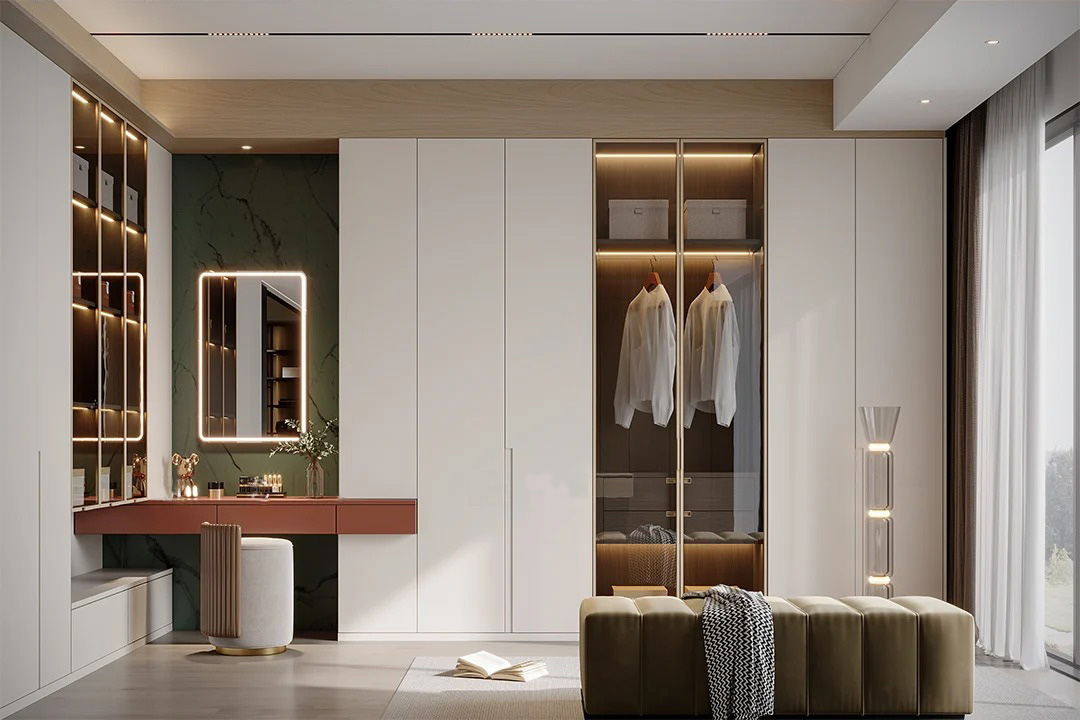
Space acts as your ultimate constraint. The way doors open dictates traffic flow within a room. Failing to calculate clearances properly ruins spatial harmony. We evaluate structural geometry to prevent these operational bottlenecks.
Clearance math determines your door style. Hinged doors require a minimum 500-600mm outward clearance. They work perfectly for larger footprints. Users can view the entire closet contents simultaneously. However, they block pathways in tight spaces.
A sliding door wardrobe solves outward clearance issues entirely. The doors glide parallel to the frame. But they introduce a different spatial sacrifice. Sliding mechanisms require thicker track framing. You typically sacrifice a minimum of 100mm in internal depth. High-load bearing top tracks become mandatory. Cheap tracks buckle under heavy door weights.
| Door Configuration | Outward Clearance Required | Internal Depth Sacrifice | Ideal Room Scenario |
|---|---|---|---|
| Hinged Doors | 500mm - 600mm | Minimal (approx. 20mm for door panel) | Spacious master bedrooms, villas |
| Sliding Doors | Zero outward clearance | 100mm - 120mm (for double track system) | Compact apartments, narrow hotel corridors |
| Bi-Fold Doors | 300mm - 400mm | Moderate (approx. 40mm) | Mid-sized rooms needing full visual access |
Evaluate the maintenance overhead carefully. Open shelving looks expansive in commercial settings. It forces users to keep spaces organized. However, it requires rigorous dusting routines. Dust settles quickly on exposed surfaces. Closed cabinetry offers superior dust-protection. It conceals messy interiors effectively. But it adds cost and mechanical complexity through hinges and handles.
Do not treat closets as isolated boxes. Transition the closet space seamlessly into surrounding furniture. You can connect it directly to a matching bedroom storage cabinet. Extend the cabinetry to form a vanity or workspace. This unifies room aesthetics. It also consolidates vendor sourcing. You save time and reduce freight costs by ordering integrated systems from one factory.
Beautiful facades often hide structural weaknesses. The core substrate dictates longevity. Proper hardware keeps doors functioning after thousands of uses. We must dig into the technical specifications to ensure lasting quality.
Wood panel selection dictates moisture resistance and weight limits. Plywood offers superior moisture resistance. It handles damp environments effortlessly. Plywood also boasts incredible screw-holding capacity. This makes it ideal for hotels and villas where heavy doors stress the hinges constantly.
High-density MDF (Medium Density Fiberboard) serves a different purpose. It provides the smoothest finish available. It serves as the perfect substrate for lacquered or veneered luxury surfaces. Particleboard offers a budget-friendly alternative. However, it swells upon water contact and drops screws under heavy loads.
| Material Type | Moisture Resistance | Screw-Holding Capacity | Best Application |
|---|---|---|---|
| Marine-Grade Plywood | Exceptional | Excellent | Tropical hotels, high-stress load areas |
| High-Density MDF | Moderate | Good | Lacquered villa cabinetry, complex routing |
| Standard Particleboard | Poor | Fair | Low-budget rentals, dry climate apartments |
Surface treatments defend against daily abuse. Thermofoil offers seamless edge wrapping. It resists moisture well but peels under high heat. HPL (High-Pressure Laminate) provides incredible impact defense. Evaluate HPL for scratch resistance and ease of cleaning in commercial settings. Natural wood veneers deliver unmatched beauty. They offer premium aesthetics but require UV-resistant coatings to prevent fading.
Cabinets rarely break; hinges do. Hardware acts as the primary failure point. Require vendor transparency on hinge opening cycles. Mandate a minimum of 50,000 to 100,000 cycles for commercial use. Soft-close piston reliability prevents slamming. You must also verify drawer slide weight ratings. Undermount slides should support at least 30kg of dynamic load.
Toxins hide in cheap glues. You must mandate stringent certifications. Require CARB Phase 2 or EPA TSCA Title VI certification. This guarantees safe formaldehyde emissions. Strict commercial building codes often dictate material flammability. Specify fire-retardant materials where local hospitality regulations demand it.
Basic boxes no longer satisfy modern users. People expect thoughtful geometry and high-tech features. Upgrades elevate the user experience from acceptable to exceptional. Small design tweaks yield massive satisfaction gains.
Proper dimensions prevent cramped clothing. Establish optimal hanging heights during the design phase.
Depth standards matter immensely. Maintain a minimum 550mm internal clearance for standard hangers. Anything shallower causes sleeves to rub against the doors.
High-end spaces demand emotional resonance. A luxury wardrobe transforms daily routines into rituals. Incorporate integrated LED sensor lighting. Evaluate hardwired versus rechargeable systems carefully. Hardwired systems offer permanent reliability but require early electrical routing. Rechargeable sensors suit retrofits better. Always monitor heat dissipation to protect clothing.
Specify premium modular inserts. Include velvet-lined jewelry drawers to protect valuables. Add pull-out shoe racks for easy access. Consider motorized hanging rods for high-ceiling designs. These pull down effortlessly, maximizing vertical real estate.
Hospitality constraints require clever consolidation. Integrate guest amenities directly into the chassis. Hide ironing boards in slim vertical pull-outs. Build tea and coffee stations into open alcoves. Reinforce base panels strategically. Heavy luggage destroys standard shelves. You need double-thick bottom boards with anti-scratch overlays to survive suitcase wheels.
A brilliant design fails if the factory cannot execute it. Procurement managers must spot red flags early. Factory selection determines your ultimate success. Installation realities introduce entirely new hazards.
Never trust a brochure. Validate factory output capabilities through actual documentation. Ask them about their machinery lines and shift schedules. Standardize a 45-60 day production window for mass orders. Insist on rigorous QA/QC documentation prior to shipping. Request video evidence of pre-assembly inspections.
Buildings are never perfectly square. We constantly encounter implementation risks on site. Accounting for environmental variations saves weeks of rework.
Establish the absolute necessity of a physical mock-up room. Build one complete sample room for hotels or apartments. Do this before triggering mass production. It exposes clashes instantly.
Shipping methods alter your labor budgets. Evaluate Flat-Pack (RTA) versus Fully Assembled delivery. Flat-pack reduces freight costs massively. It minimizes transit damage risk. However, it shifts the labor burden heavily onto your on-site contractors. If you choose flat-pack, ensure detailed CAD assembly instructions arrive with every box. Missing hardware packets stall progress. Fully assembled units install faster but cost a fortune to ship. They also risk frame racking during transit.
Specifying storage solutions for commercial and high-end properties involves rigorous technical oversight. The cheapest initial quote often masks subpar hardware or non-compliant materials affecting long-term durability. We emphasize scrutinizing core boards, hinge cycles, and safety certifications before signing contracts. Structural layouts must respect spatial geometry, balancing outward clearances with internal depths.
We advise stakeholders to execute a strict action plan. First, audit your floor plans for exact clearance measurements. Second, define your definitive feature list, including ambient lighting and hidden safes. Finally, request a localized prototype or material sample box from shortlisted suppliers. Taking these precise steps ensures your finalized installations withstand daily wear while delivering outstanding aesthetic value.
A: Bulk orders typically require 8-12 weeks total. Design approval and shop drawings take 1-2 weeks. Mass production requires 45-60 days. Ocean freight shipping and customs clearance generally add another 3-4 weeks depending on the destination. Always build a buffer into your construction schedule.
A: Plywood dominates wet or humid environments. It resists moisture swelling and holds heavy door screws securely. MDF costs less and provides a smoother surface for paint, but it degrades quickly if exposed to water. Use plywood for hotel durability and MDF for dry, luxury residential finishes.
A: You need a minimum overall depth of 600-650mm. Standard hangers require 550mm of internal clearance. The sliding track system typically consumes 80-100mm of depth. Falling below 600mm causes clothing sleeves to catch in the moving doors, damaging both the mechanism and the garments.
A: Retrofitting hardwired lighting is highly difficult. It requires drilling through structural panels to hide cables. Power source limitations often force you to use unsightly surface-mounted wires. Factory pre-installation routes cables invisibly. If you must retrofit, use battery-operated, motion-sensor LED strips to avoid complicated electrical work.


